WordPress Discovery Services for Smarter, More Strategic Websites
Every WordPress project comes with its own requirements, priorities, complexities, and challenges. Our WordPress Discovery service helps you make sense of them and establish a clear roadmap for your project.
Through focused stakeholder sessions and a review of your existing platform, content, integrations, analytics, and SEO requirements, we identify the steps that should be taken to make the project successful.
You get documented requirements, prioritized recommendations, key risks and dependencies, and a roadmap your team can use to plan the next phase.
What Is WordPress Discovery?
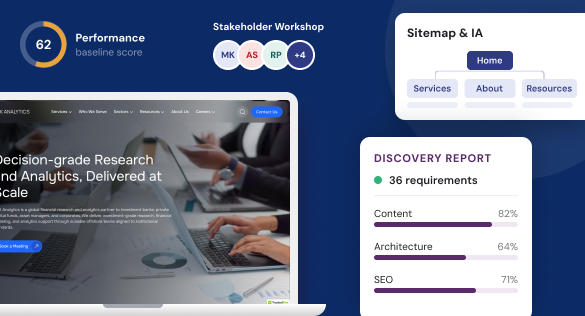
WordPress Discovery is a methodical approach to determining what your website needs to do and how it should be designed and developed before implementation even begins. Instead of starting with design and development, we begin by understanding your vision, objectives, users, content, and technical environment.
The process of discovery is especially helpful when the scope of the project involves many stakeholders, brands, regional websites, languages, legacy systems, large content libraries, custom features, or third-party integrations. As there are many interdependencies, there is a need to identify these up front.
Discovery is all about connecting the dots between business goals, audiences, content architecture and information architecture, the user experience and search, and the technical architecture. In other words, a direction, rather than a set of recommendations.
What Enterprise Website Discovery Covers

Goal & requirements gathering
We start by discussing the results required of the project. This would involve analyzing the business objectives, website objectives, the needs of the audience, functions, content, conversion goals, and measurements of success, as well as any technical, operational, and budget constraints that would have to be taken into account
This information would be gathered using tried and tested techniques such as stakeholder interviews, requirements workshops, an analysis of your current website and content, an analysis of existing technical documents, analytics and search data where possible, user journey mapping, and any competitive or market context.
Information gathering isn’t an end in itself but rather serves to create a more holistic view of the project.

Stakeholder Alignment (Marketing, IT, Leadership)
Enterprise website initiatives bring together stakeholders with different responsibilities and success measures. Discovery brings marketing, leadership, IT, content, design, and delivery teams into a structured decision-making process.
Marketing will have its needs, IT will have its technical needs, leadership will have their priorities, and your content, design, and development teams will have their own list of needs for the website.
Workshops will identify conflicting needs, decision rights, approvals, and dependencies early on in the process. This is not about consensus for the sake of consensus, but about clarity and decisions.

Technical/content audit of existing site or legacy CMS
Before we suggest what could change, we start by looking at what already works.
On the tech side, we make an in-depth analysis of your CMS or platform, whatever that may be, whether you use WordPress or something different, themes, plugins, custom functionality, integrations, APIs, hosting, and infrastructure, as well as consider its performance and security aspects.
When it comes to the content part, we analyze the existing content (whether this is blog posts or articles, case studies, ebooks, white papers, or anything else) as well as content structure, page structure, navigation and taxonomies, and determine which parts are outdated and which must be retained, upgraded, merged, or eliminated.
When it comes to the SEO part, we analyze the URL structure, metadata, internal and external links, indexing, redirects, schema markup, and organic performance and migration risks.

Identify Feasibility, Risks, and Dependencies
Discovery allows you to validate critical assumptions before they become delivery issues. We consider whether the proposed technology can satisfy the requirements, the way systems are supposed to interact, and any limitations of the existing plugins or services.
We also try to identify possible issues early on, whether they relate to integrations, the existing systems, content migration, or performance. All risks cannot be predicted, but knowing the critical ones up front will help your team make better decisions and proceed to development.

Build a Realistic Project Direction
Everything we learn from this discovery process turns into an actual plan that consists of such aspects as the scope of the project, its priorities, must-have elements, expectations of people involved, resources needed, and phases of the project.
The scope and assumptions are identified first when creating an implementation estimate. The discovery process helps to estimate efforts, budget, and schedule in a better way; however, the final estimates still depend on validated requirements, technical findings, and the defined scope.


Why WordPress Discovery Matters Before You Build
When project requirements, technical dependencies, and priorities aren’t well defined prior to design and development, the project is at risk of scope creep, delays, and extra expenses later when the project is halfway through. The process of discovery can help to identify all these challenges prior to the start of your work.
Start With a Clear Project Scope

Discovery establishes what is needed for the project, what is most important, and what falls into the agreed scope. That means functional and technical requirements, content needs, dependencies, and priorities are documented and finalized. By involving marketing, leadership, IT, content, design, and in-house development teams in this discussion, we create a common understanding of what should be done.
Reduce Changes During Development

The requirements that have not been discussed or documented usually come to light later on, especially when development has already started. Reviewing stakeholder expectations, content, integration, and technology early in discovery helps minimize changes caused by unknown or misunderstood requirements.
Align marketing, design, tech, SEO, and content teams
Decisions by marketing, design, technology, SEO, and content teams affect one another. Discovery creates space for those teams to discuss requirements together, so decisions about content, user experience, or functionality account for the wider project rather than creating problems for another team later.
Identify Technical Challenges Early

The tech stack, custom development, infrastructure, and integration each come with their strengths and weaknesses. Discovery will allow you to determine the viability of your solutions and make informed decisions about replatforming.
Plan for SEO From the Start

SEO cannot be added after building a website. It needs to be taken care of beforehand. In other words, things like information architecture, URL structure, redirects, indexing, metadata, schema markup, internal linking, and so on.
It should also consider how the site should be structured for how people are searching today, including through AI-assisted search tools where relevant.
Build for Long-Term Growth

This website has to be able to scale and grow with your business, whether this means more content needs, more functionality needs, more integration needs, or even more traffic needs. This is where the Discovery process helps us prepare for growth. This process includes information on how the platform will be scalable, flexible content modeling, and custom workflows that can handle future demands.
For WordPress projects of larger scale, this is particularly true. Growth is the key here.
What Happens If You Skip WordPress Discovery?
01
Scope Creep and Mid-Project Changes
Many times, when such requirements are vague and not specified, they emerge later on as added features or changes in priorities. These can turn out to be outside the scope of work in which case they take up additional resources of time and money. It will help if requirements are handled early enough before they lead to additional costs and changes later in the project.
02
Misaligned Stakeholders
The stakeholders will definitely have different priorities when entering into the website project. The marketing team, IT team, the management, the content team, the design team, and the development team will all have different priorities and different definitions of success.
If there is no proper process in place to resolve such differences, then these will surface later in the form of conflicting priorities, delayed decision-making, repeat discussions, and lack of ownership. This will lead to a slowing down of the process since the teams will keep going around in circles.
03
SEO and Content Loss During Migration
CMS migration involves more than page and media migrations alone. The lack of an adequate plan means that things such as URL mapping, metadata, internal links, redirects, and other SEO-related issues might be forgotten about.
Neglecting such issues can have serious repercussions once the launch is done, such as having broken links, a lower search visibility, less organic traffic, and much more cleanup work than needed in the first place.
04
Technical Dead Ends
Failure to make decisions on the technologies, from the tech stack to the server infrastructure, without first doing an assessment can cause major problems in the future, such as compatibility, restrictions, or having to redo some parts. This is also true for the workflow of a business.
Failure to understand the workflow, permissions, and data flow before developing the new website from scratch or migrating from one platform to another can result in functionality that does not work as expected.
05
Budget Overruns
Late identification of requirements or technical problems in any project will incur higher costs in solving those requirements and issues than if they had been discovered early on.
Discovery does not guarantee lower project costs. Its value is in making scope, complexity, risks, and assumptions more visible before you commit to implementation budgets and timelines.
06
Delayed Launches
Unresolved requirements, external dependencies, technical issues with development, slow ddecision-making,and frequent change can all impact a delivery schedule. RRecognizingwhat can be planned in advance and allowing for change as more becomes known is key to realistic planning by the team.
What We Explore During WordPress Discovery
During the WordPress Discovery, we explore the business goals, the needs of your audience, your content, the technology you currently use, any integrations, search engine visibility, performance, security, and accessibility of your current website. Each area is explored in as much depth as is required during the respective assessment(s).
All of these areas impact each other, and we will assess them together to ensure that our recommendations are suitable for the people using the website, the teams that manage the website, and the systems that support the website.

Business & Project Goals
We clarify the business outcomes of a website, the actions you want users to perform, the KPIs that measure progress for you on the website, and any constraints that the project is working within.

Audience & User Journeys
An analysis of your audiences, their goals for visiting your website, how they reach it, and where they encounter pain points. This is used to understand their requirements of your website’s navigation, page structure, content, and key user journeys.

Content & Information Architecture
Existing content, a content inventory, a content hierarchy, a site’s navigation, its taxonomies, and the different types of content that will be published on the site are key components to help users access information on a website while at the same time creating structure for your content team to manage content effectively on the website.

UX & Design Requirements
Your existing design system, brand guidelines, UX/UI assets, design templates, low-fidelity or high-fidelity wireframes, if you have any, and accessibility considerations, too. While Discovery research can cover all of the above, it doesn’t replace the design work.

WordPress Architecture
Our take on WordPress setup, themes, plugins, custom functionality, content architecture, multisite considerations, editorial workflows, scalability, and maintainability is driven by your project and business needs & technical requirements.

Integrations & APIs
Integrations & APIs: CRM, marketing automation, analytics tools, ERP, payment systems, third-party services, and custom APIs, where you want to integrate, what data needs to go where, and what other dependencies there are.

SEO & Search Requirements
We consider URL structure, redirects, metadata, structured data, internal linking, and content organization, to name a few factors, when looking at the requirements of search and how they can be incorporated into the wider website plan. The goal is to account for SEO needs during decision-making, rather than treating them as a last-minute check.

Performance, Security & Accessibility
Core Web Vitals, page performance, hosting options, and security / accessibility / scalability considerations all need to be considered up front as part of the project plan and architecture.
Our WordPress Discovery Process


Project & Requirements Discovery
We work with your stakeholders to understand the business goals, website objectives of your business, user journey, content architecture, functionality, the technical requirements, and the priorities of your project through stakeholder interviews,
We also audit your website to identify issues and suggest improvement in terms of performance, technical SEO, UX/UI issues, security, and many other factors.


Research & Stakeholder Workshops
We analyze our findings based on business impact, user value, technical feasibility, project priorities, dependencies and efforts required to implement them. We differentiate between essential and important requirements as well as future improvements and required actions for your team.


Website & Technical Assessment
The assessment of your current website, including CMS architecture, sitemap, content types, content architecture, server configuration, themes and templates, plugins or extensions, integrations, APIs, Technical Search Engine Optimization (SEO), performance, security, database, assets (media, files, documents), and constraints.


Strategy & Solution Planning
The results from the findings are then used to create specific recommendations for the website’s information architecture, the content structure, user journey, server configuration, traffic scalability, and custom workflows. This then defines the best approach for the WordPress architecture, required features, any integrations, and technical SEO considerations to ensure performance and scalability.


Roadmap & Recommendations
All of this translates into a clear direction for your project. We develop a project scope, define the priorities, describe the required steps and consider time frames for the individual phases.
When Should You Consider WordPress Discovery?
Enterprise websites typically involve many individuals and teams that manage large volumes of content and need complex integrations, high performance and security requirements ,as well as a range of governance constraints.
Through the Discovery process, we document these considerations in a single plan, outlining key stakeholder roles, required approval processes, required content, and the site’s potential architecture.
This type of project is particularly relevant for multilingual websites, brand consolidation, multisite networks, and large programs that require building several websites to be published on a single platform.
Decisions made during the discovery phase regarding the website’s governance, content, architecture and ownership will shape the website as your business evolves and ensure it is able to continue to meet your current needs whilst remaining manageable as your business grows.
When embarking on a website redesign, there are many factors to consider on what to keep, how to improve and what needs to change.
The discovery process can help set the direction for the redesign based on user needs, current content, website performance and technical constraints.
This will help set the overall goals for the new website and outline the areas that need to be addressed prior to getting into design and development.
A CMS migration to WordPress is more than just moving content from one platform to another. To set up the migration properly,
In the Discovery phase, we analyze the current CMS and its limitations, the content and its structure, the current URLs and how to map them to the new system, SEO requirements and possible risks, current plug-ins and integrations, content models and templates, and technical and project dependencies.
(See our CMS Migration services for platform-specific migration support.)
WordPress Multisite structure affects how sites in the network share functionality, how teams of authors manage their content, and who is in charge of things like access and governance. Discovery helps determine whether Multisite is the right option and outlines the desired network structure and shared features, as well as ownership and control for individual sites and the network as a whole.
For large content websites, beyond just publishing new pages, discovery will explore the content models, taxonomies, the site’s hierarchy, search capabilities, server infrastructure needs to scale during peak load, and how the publication process can be optimized of a large library of content.
Custom WordPress functionality and features need to have clear objectives before they can be built. Discovery establishes what is required for custom functionality and features to function properly. This covers custom functionality and features as well as technical requirements, user and business workflows and third-party integrations in addition to development dependencies and constraints.
For Ecommerce projects, the discovery phase defines a scope that encompasses the product/catalog structure, user experience, checkout/payment process, and related processes like order management, shipping, tax, etc., as well as potential integrations with 3rd party APIs, analytics, CRMs, marketing automation etc.
Complex marketing websites do more than just present information about products and services. They support multiple campaigns, different audience groups, various landing pages, and lead generation flows. They also integrate with a company’s CRM and marketing automation systems.
Discovery looks at how all these elements work together. During discovery, we review the content, the user journey through the website, SEO, analytics, conversion tracking, and the website’s technical setup.
This allows the marketer and the other stakeholders to understand what is required from their website and how it can be used to support marketing activities before development begins.
Why Choose WPoets for WordPress Discovery?
Deep WordPress Expertise
Our deep expertise with WordPress spans building enterprise-class websites, custom themes/templates and plugins, website migrations to WordPress, integrating 3rd party services with WordPress, maximizing website performance and undertaking ongoing website maintenance and support work.
We bring 17+ years of lessons learned in building Deep WordPress Expertise to shape recommendations and prioritize the key issues to address during the discovery phase.
Business & Technology in One Conversation
Effective discovery evaluates business and marketing objectives alongside architecture and delivery constraints, so recommendations are commercially relevant and technically actionable.
WPoets integrates your business goals and technical needs so that the direction that we can develop for your site is something that can actually be built.
Cross-Functional Expertise
Our discovery process draws on over 17 years of collective expertise in strategy, user experience, WordPress development, SEO, WordPress consulting, infrastructure management, and more.
By having all these perspectives covered right from the start of our discovery, we can reveal key trade-offs, dependencies and opportunities early on rather than later when they may become more difficult to manage.
Built for Marketing Teams
We make it easy for the people who will run the website after launch: editorial workflows, publishing permissions, content governance, search engine optimization, analytics, conversion tracking, and easy updates in the editorial backend without depending on developers.
This backend is built to give your team the freedom to update their website without having to create developer tickets.
Designed for Scale
During the Discovery Phase, we will also identify what your current site may need in the future (e.g. ,more content, more traffic, new features, more integrations, and a multilingual version merging multiple web properties). We will also identify the ongoing maintenance needed to keep your site running optimally.
Instead of making vague promises about being “future-proof,” we make practical decisions now that can support your website as your needs grow and change.
From Discovery to Continuous Improvement
The Discovery process lays the foundation for all the other aspects of your website’s development, i.e., user experience, design, development, moving to a new CMS, hosting your website, and above all, maintaining it and optimizing it for the best results.
We will support you in all these aspects when the time is right for you and your team.
What You Get From Our WordPress Discovery
The end result of our discovery process is an action plan your team can actually use — not some bland slide deck or feel-good impressions. Specifically, you can expect to get:
Project requirements document
A consolidated brief covering business goals, functional requirements, and technical requirements of your business and marketing needs, the needs of all stakeholders, constraints, assumptions, and all project dependencies
It gives everyone a starting reference point for the project.

Business and technical requirements
Turn your business goals and marketing aims into clear, uusable‘tech specs’ that can be used by designers and developers to ensure your new website meets your objectives.

User journey mapping
User journey mapping for the main user journeys through your website and the needs of your users at each stage of their journey through your website and how these needs influence your page structure, content and conversion objectives.
Information architecture
A proposed information architecture for the project (how pages and content types might be organized and how they might relate to each other). The detail provided will be in line with the scope of the project.
WordPress architecture recommendations
Recommendations on use of plugins, custom functionality and integrations, content architecture, use of WordPress Multisite for multilingual sites and for scalability.
Feature prioritization
We provide a list of features prioritized by business value, user value, and technical feasibility. We take into account project priorities, dependencies, and considerations for implementation.
Project Roadmap
A roadmap outlining the recommended scope of work, the priority of requested features, key dependencies, proposed project structure, deliverable timelines, and schedule considerations.
Frequently Asked Questions
What is WordPress Discovery?
WordPress Discovery will outline key goals for the new website, define primary audience and stakeholders, and outline key elements of the project prior to us beginning the design and development work.
It clarifies requirements, key decisions, and even assumptions that can be tested early on in the process.
Why do I need WordPress Discovery before development?
In summary, Discovery identifies and resolves key issues before you start building a new website, such as what you need from a website, your stakeholders’ needs, the technical requirements, potential problems, and the direction you're taking.
This helps us identify and address potential challenges and risks early, before development is underway.
What does a WordPress Discovery process include?
The scope of the discovery work includes requirements gathering, a series of workshops with key stakeholders, an analysis of the current website/CMS and its content, solution options, and a documented roadmap with key priorities and next steps of work.
How long does WordPress Discovery take?
The timeframe for Discovery depends on several factors, including scope, number of stakeholders, current platforms, integrations, and key questions that need to be answered. With sufficient information, we can recommend an appropriate approach and subsequent timeframe for delivering results.
It can take from 4 weeks to 8 weeks or more to complete the entire discovery phase.
What deliverables do I receive from WordPress Discovery?
Based on the agreed scope of work, the results of the discovery can include documented requirements, suggestions for the best architecture for the new WordPress site, information architecture, a review of the technical SEO considerations, and the main features to implement.
The outcomes will help define a project roadmap with key priorities for your team to take on next.
Can WPoets conduct discovery for an existing WordPress website?
Yes. We can run discovery against an existing WordPress website and review it against your current business objectives. We can examine in detail the existing website architecture, content, technical SEO, integrations, etc., and provide a detailed assessment of current performance and identification of items for future improvement.
Do I need discovery before migrating to WordPress?
This is crucial to establish a solid foundation and to uncover hidden issues with your content, URLs, website structures, technical SEO, server scalability, ongoing maintenance and support needs, and integrations that could potentially cause problems in your replatforming efforts if you were to embark on these without proper analysis first.
Can WPoets handle design and development after discovery?
The output from the discovery will be yours to use as you see fit. It can act as a stepping stone to continue to work with us through the UX and design phases, the development phase, the migration to WordPress, and the subsequent ongoing maintenance and continuous improvements.
How much does WordPress Discovery cost?
Discovery pricing depends on the complexity of the project, the current platform, the number of integrations, and the level of depth you would like WPoets to complete the assessment. Contact us to go over the details of your project to establish the best scope for the WordPress Discovery for you.