

Published on Oct 30, 2026 | Updated on Oct 30, 2026
Why Businesses Compare Sitecore and WordPress


Most CMS evaluations start with a trigger event like a CMS end-of-life, a contract deadline, a budget review, a merger, consolidating multiple websites into one, or a team tired of slow publishing
Understanding your trigger matters because it shapes what “the right platform” means for your organization. A team facing a Sitecore renewal has different priorities than a team recovering from a merger with two competing CMS instances.
Common Reasons Businesses Start This Evaluation
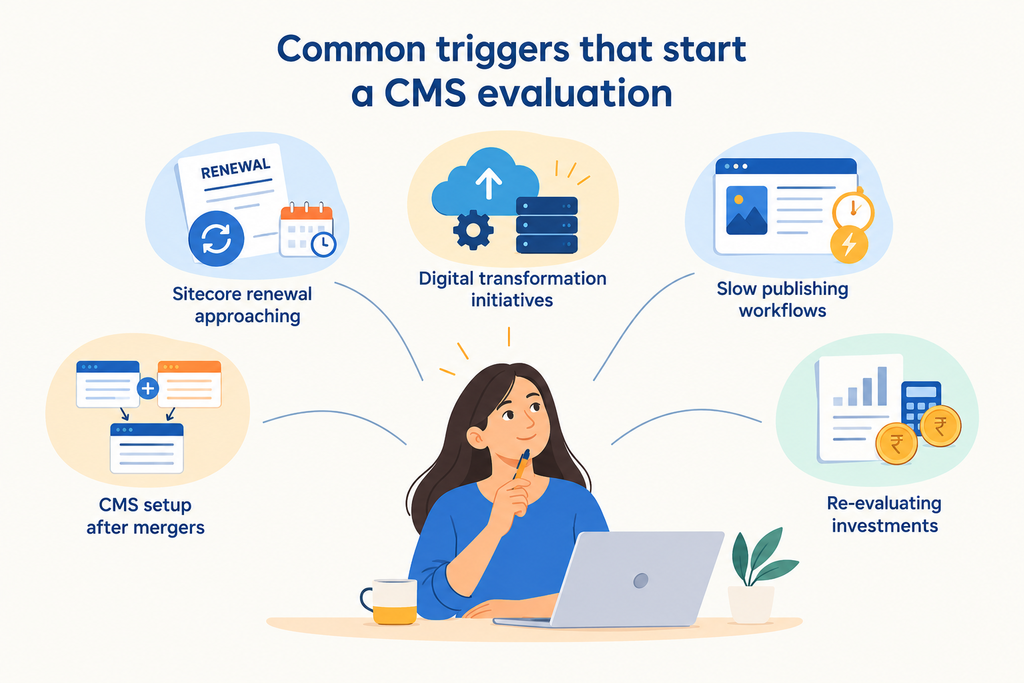
Sitecore renewal approaching
It’s often during the renewals that organizations question their CMS cost. A renewal notice forces a decision: renew as-is, renegotiate, or evaluate alternatives.
Digital transformation initiatives
When organizations run bigger modernization projects, consolidate their tech, move to the cloud, or shift to composable architecture, a CMS change often gets pulled in.
If a project already touches infrastructure and integrations, it’s a good time to ask if the CMS still fits.
Slow publishing workflows
This is often the first complaint from marketing teams. Every page update may need a developer. Campaigns take weeks instead of days.
When the CMS slows down every idea, leadership starts asking if the platform itself is the problem.
CMS setup after mergers
Mergers and acquisitions often leave companies running two or more CMS platforms at once. This can mean managing multiple websites with no clear content strategy, inconsistent branding, and no single source of truth.
Consolidating onto one platform becomes its own project, and it’s a natural moment to pick which platform to standardize on.
Re-evaluating investments
Sometimes there’s no single trigger. Finance just asks what the website costs, what it delivers, and whether that’s still worth it three or five years into the current platform.
Common Evaluation Mistakes
Knowing why you’re evaluating is only half the job. Most evaluations fail because of how the comparison was done.
Comparing licensing instead of total cost of ownership
Considering the license cost is not the only thing you should be considering. It leaves out setup, hosting, integrations, upkeep, and the specialists needed to support the platform. Two platforms with similar license costs can still have very different five-year totals.
Assuming Sitecore is the only enterprise option
Sitecore is a well-known name in the DXP space that can lead teams to treat it as the default enterprise choice, without checking if they really need a full DXP.
Some enterprises might just need a well-built, well-hosted CMS and not a complete DXP like Sitecore.
Ignoring long-term maintenance
Migration projects tend to focus on the build. But the higher costs, like patching, upgrades, plugin management, and the developer hours needed to keep the site healthy, show up after launch.
Skipping content and integration audits
Every existing CMS has accumulated content, custom fields, and integrations like CRM connections, marketing automation, analytics, and single sign-on.
Teams that skip auditing this before comparing platforms often discover mid-migration that a “simple” move is actually a complex one, on either platform.
Letting one team’s requirements drive the decision
Marketing wants publishing speed, while IT wants security and maintainability, and finance wants predictable cost. A CMS decision driven by only one of these perspectives tends to create friction later.
Therefore, it’s important to consider everyone’s view before deciding.
Published on Oct 30, 2026 | Updated on Oct 30, 2026

