

Published on Oct 30, 2026 | Updated on Oct 30, 2026
Understanding the Platforms


Before comparing Sitecore and WordPress on cost, architecture, or scalability, let’s understand what each platform actually is and who it was built for.
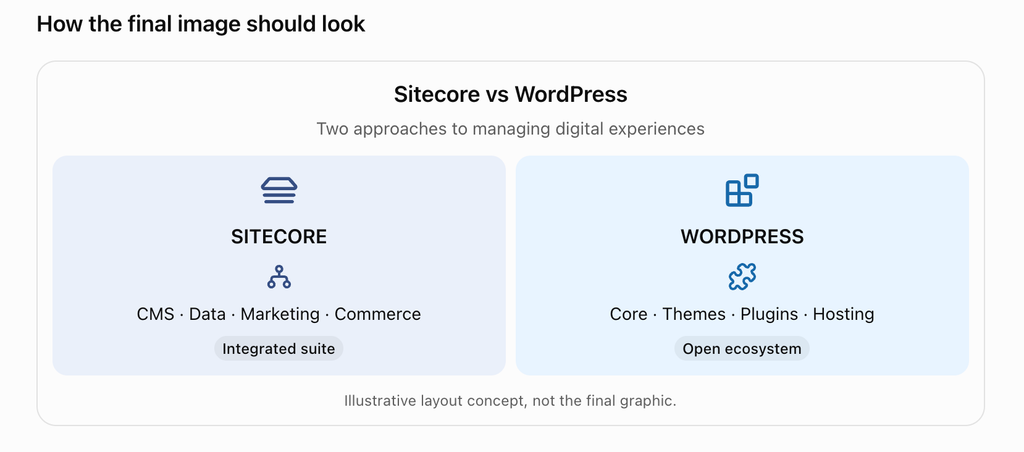
Sitecore and WordPress overlap in some areas and diverge sharply in others. Knowing the baseline helps you evaluate everything that follows with the right context.
What Is Sitecore?
Sitecore is a closed-source, digital experience platform (DXP) built on the Microsoft .NET stack.
It’s not just a CMS. Sitecore bundles content management with marketing automation, customer data, personalization, and commerce tooling into a single suite.
Core products in the Sitecore suite:
- XM (Experience Manager): The traditional content management layer
- XP (Experience Platform): XM plus customer analytics and marketing automation
- XM Cloud: Sitecore’s current cloud-native, headless-first offering
- Content Hub: Digital asset and content operations management
- Personalize: Real-time personalization and testing, sold separately from core CMS
- OrderCloud: A commerce API layer for complex B2B/B2C use cases
It may take a while to understand Sitecore’s pricing structure because each of these can be licensed individually or as a part of the bundle
Sitecore’s Market Share
According to data from W3Techs, Sitecore is used by 1% of all website users worldwide. Its usage is seen to have declined in recent tracking periods.
Here’s a closer look at the numbers:
| Measure | Number |
| Live Sitecore websites | 12,318 |
| Live sites in the United States | 5,526 |
| Live sites in India | 968 |
| Sites in the top 100,000 | 677 (0.68%) |
Numbers taken from BuiltWith as seen in October 2026.
Who Sitecore is built for
Sitecore fits large enterprises that need:
- Personalization tied to a unified customer data platform
- Multi-brand or multi-region content managed under one system
- Deep integration with an existing Microsoft/.NET technology stack
- A single vendor accountable for CMS, marketing automation, and commerce together
It’s a strong fit when your organization has already chosen Microsoft infrastructure and has the budget and in-house .NET expertise to support it.
What Is WordPress?
WordPress is an open-source content management system, originally built for blogging in 2003 and now running a large share of the web across every business size.
There are two ways to run WordPress, and this distinction matters more than most comparisons acknowledge:
- WordPress.org (self-hosted): Free software you install on your own hosting. This gives you full control, but you’re responsible for hosting, security, and maintenance, or you hire a partner to manage it.
- Managed hosting for enterprise WordPress: Platforms like Kinsta, Pagely, WP Engine Enterprise, or AwesomeOps (a WPoets service) handle hosting, security, scaling, and platform updates, while you retain full control over customization and content architecture.
A basic self-hosted WordPress site isn’t a fair match against Sitecore’s managed cloud. The right comparison is Sitecore CMS with WordPress CMS with managed hosting, not a vanilla WordPress install.
WordPress’s Market Share
According to data from W3Techs, WordPress is used by 41% to 43% of all website users worldwide.
That scale matters for a practical reason: it means a deep, competitive talent pool, a mature plugin ecosystem, and a platform unlikely to disappear or get acquired.
Here’s a closer look at the numbers:
| Measure | Number |
| Live WordPress websites | 37,259,080 |
| Live sites in the United States | 16,814,166 |
| Live Sites in India | 712,650 |
| Sites in the top 100,000 | 18,652 (18.65%) |
| Free plugins in the WordPress.org directory | 59,000+ |
| Live WooCommerce stores (Q2 2026) | 4,341,142 |
Numbers taken from BuiltWith, Webtonic, and Store Leads via PureThemes as of October 2026.
What gives WordPress its flexibility?
- Themes and page builders handle presentation without custom development for most needs.
- Plugins extend functionality like SEO, forms, e-commerce, and integrations without building from scratch.
- A large developer ecosystem provides developers to help with any custom work when needed.
- Lower baseline ownership costs, since the core software carries no license fee; implementation costs & maintenance costs are lower.
A WordPress site built with too many plugins, no update strategy, and no dedicated hosting plan accumulates technical debt just like any platform.
Published on Oct 30, 2026 | Updated on Oct 30, 2026

